
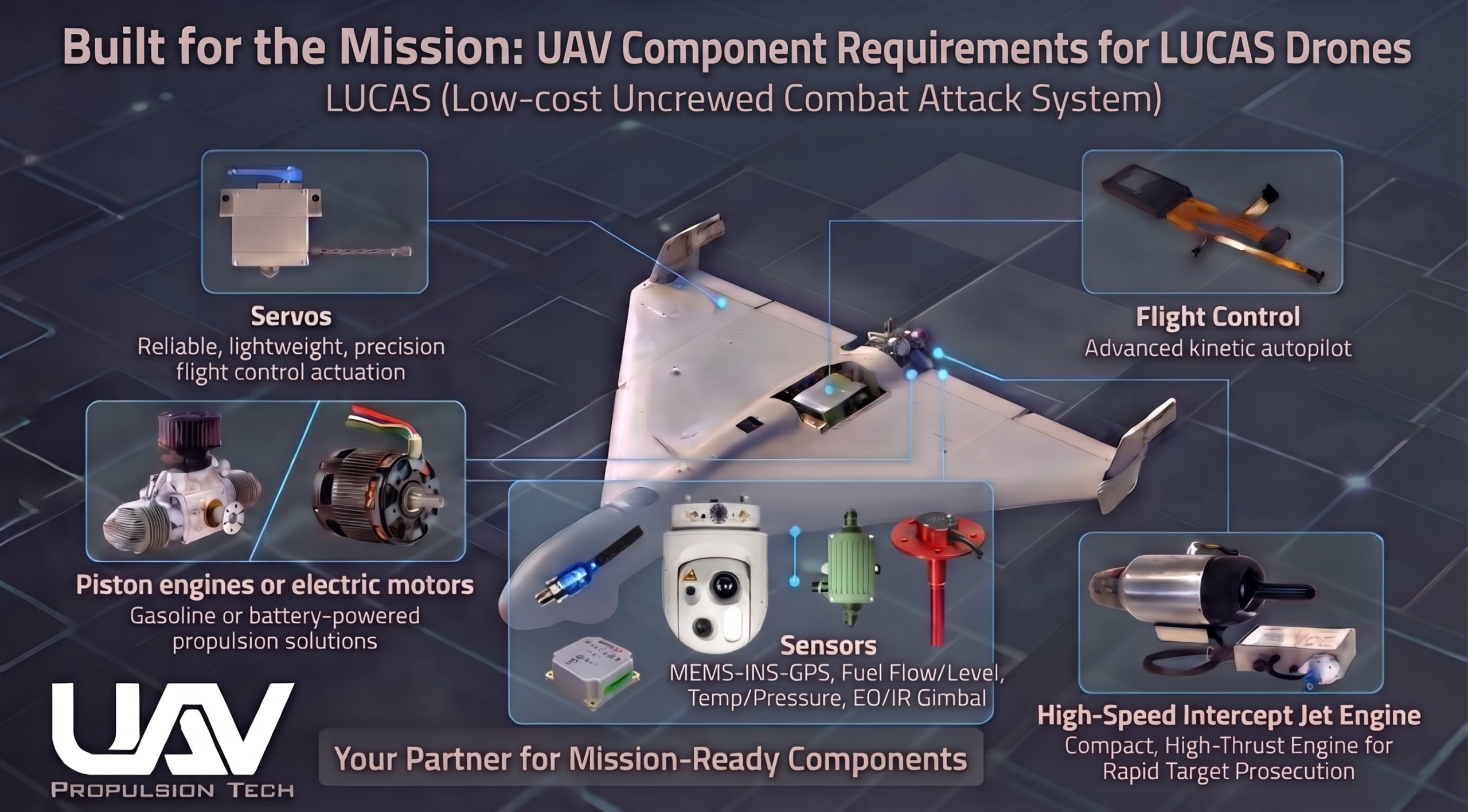
The development of low-cost unmanned aerial vehicles (UAVs) is placing greater emphasis on the relationship between component performance, system reliability, and acquisition cost. The LUCAS (Low-cost Uncrewed Combat Attack System) program is a reflection of this shift, with the U.S. Department of War (DoW) funding development and procurement activities for systems targeting a price range below $50,000 per unit.
Working within such a cost target requires a different approach to component selection. Rather than evaluating each component exclusively on its individual capabilities, developers must consider how propulsion, flight control, sensing, and supporting systems contribute to the requirements of the complete aircraft. The objective is to establish a suitable balance between capability, reliability, manufacturing considerations, and cost. Component selection becomes a central part of that equation, particularly when procurement targets place pressure on the cost of the entire platform.
For UAV manufacturers and component suppliers, LUCAS highlights the importance of commercially available technologies that can meet defined requirements without introducing unnecessary complexity or integration costs.
Propulsion Systems: Balancing Power, Weight, and Cost
Propulsion selection for LUCAS requires balancing power output, aircraft weight, endurance, and acquisition cost. With a target price below $50,000 per system, the choice between combustion engines and electric propulsion becomes an important consideration, depending on the aircraft’s configuration and performance requirements.
Combustion engines can be evaluated for platforms requiring sustained power and fuel-based energy storage, while electric propulsion offers a different set of integration and performance characteristics. In either case, the engine or motor must be assessed alongside its supporting components, including fuel systems, power electronics, and propellers where applicable. These requirements influence both the initial component cost and the overall complexity of the aircraft.
UAV Propulsion Tech provides access to propulsion technologies from specialized manufacturers, including Suter Industries, AMT, and Plettenberg.
Suter Industries supplies combustion-engine solutions, while AMT specializes in micro gas turbine technology and Plettenberg offers electric motors. These technologies represent different propulsion approaches that can be assessed against the aircraft’s specific power, weight, and integration requirements.
For a cost-constrained program such as LUCAS, the central consideration is the suitability of each propulsion system for its intended application, alongside its acquisition cost and supporting hardware requirements. Evaluating the complete propulsion package, over the engine or motor price alone, provides a more meaningful basis for component selection.
Flight Control: Integrating Navigation and Avionics
Flight-control systems form another important part of the UAV component architecture. An autopilot combines flight-control functions with information from onboard sensors and navigation equipment to maintain the aircraft’s intended flight behavior. Its compatibility with the airframe, avionics, and other onboard systems influences integration effort and system-level reliability.
For a cost-constrained program, an autopilot must be assessed not only on its purchase price but also on the capabilities already incorporated into the system. Integrated functions and compatible interfaces can help reduce the need for additional hardware or extensive integration work, depending on the requirements of the aircraft.
Developers must also consider environmental suitability, documentation, software and hardware interfaces, and the level of reliability required for the intended application. These factors help determine whether an available commercial solution is appropriate or whether further customization is necessary.
UAV Propulsion Tech supplies navigation and autopilot solutions from Embention, including the company’s Autopilot LM product family. These provide a basis for evaluating flight-control options against platform-specific requirements. Embention’s VERONTE KAI 2.0 combines flight control capabilities with onboard AI, vision-based guidance, and multi-layer positioning technologies. Its features include GNSS-denied navigation, autonomous target engagement, multi-drone formation flight, and multiple command-and-control communication links, including LOS, 4G/LTE, SATCOM, and Starlink. The system also incorporates anti-jamming and anti-spoofing capabilities, with visual navigation techniques supporting positioning when satellite navigation is unavailable.
For LUCAS-related procurement, the consideration is how an autopilot fits into the overall system architecture and cost target. A component’s value depends on the capabilities it provides, its compatibility with other equipment, and the integration work required to bring the aircraft together.
Sensor Systems: Supporting Reliable Aircraft Operation
Sensors provide information that onboard systems use to understand aircraft conditions and support flight management. Depending on the aircraft architecture, these can include navigation sensors, inertial measurement systems, airspeed sensors, and equipment for monitoring propulsion-system performance.
The requirement is not necessarily to maximize the number of sensors onboard. Instead, developers must determine which measurements are necessary for the aircraft’s intended functions and select components that provide suitable accuracy, environmental performance, and compatibility.
Sensor selection also has implications for cost and integration. Different devices may use different interfaces, require separate supporting electronics, or introduce additional calibration and installation work. Considering these requirements early can help reduce avoidable complexity during system integration.
UAV Propulsion Tech’s portfolio includes navigation systems, MEMS-INS-GPS solutions from Aeron Systems, Vectoflow’s airspeed sensors, as well as fuel and engine monitoring sensors. These product categories address different measurement requirements across unmanned aircraft systems.
Through AvioRace from Italy, we also provide high-performance temperature and pressure sensors designed for UAVs and remotely piloted aircraft systems.
The selection process should begin with a clear understanding of the information the aircraft needs, followed by an assessment of suitable sensors and their compatibility with the rest of the avionics architecture. This approach helps ensure that sensor procurement remains connected to actual system requirements rather than becoming an exercise in adding hardware without a defined purpose.
Actuation and Supporting Components
Flight-control electronics depend on compatible hardware to translate commands into physical movement. Servos and other actuators, together with their associated power and mechanical interfaces, are therefore important parts of the wider aircraft architecture.
For cost-conscious UAV programs, these components must be evaluated in terms of weight, reliability, operating environment, power requirements, and compatibility. An inexpensive actuator may create additional integration or replacement costs if it does not meet the required operating conditions.
Supporting components also deserve attention. Power distribution, engine monitoring, mounting arrangements, and other interfaces can affect the installation and operation of primary systems. Their individual costs may appear modest, but the cumulative effect of these components can influence the overall procurement budget.
UAV Propulsion Tech also offers gyrostabilized gimbals from Merio for electro-optical/infrared (EO/IR) imaging. Merio’s Milvus range is designed for aerial applications, with configurations combining daylight and thermal cameras. For low-cost UAV programs such as LUCAS, EO/IR imaging options must be evaluated against the aircraft’s payload requirements, integration needs, and overall cost target.
Although the suitability of any particular component depends on the aircraft’s requirements, access to different product categories can help developers assess their options across a broader supply chain.
The key principle is that supporting hardware should be considered alongside major components from the beginning of the procurement process. Doing so provides a more complete picture of the equipment, interfaces, and integration work required for the aircraft.
Designing Within a Cost Target
A sub-$50,000 target places the economics of component selection at the center of the LUCAS development context. Achieving an overall price target requires an assessment of how individual purchases contribute to the total system, including integration, supporting equipment, testing, and production considerations.
Standardized interfaces and suitable COTS components may help reduce engineering effort when they meet the platform’s requirements. Custom solutions can remain relevant where an established product does not provide the necessary characteristics, although customization may introduce additional development costs and lead times.
The appropriate balance will depend on the aircraft architecture, production volume, supplier availability, and performance requirements. Procurement decisions should consequently consider the complete cost of incorporating a component, rather than relying on its initial price alone.
For suppliers, this creates an opportunity to support manufacturers with clearly documented specifications, appropriate product options, and an understanding of how individual technologies fit into wider UAV systems. Access to established components can help simplify the sourcing process, provided that technical compatibility and program requirements remain central to the selection.
A Mission-Driven Approach to Component Sourcing
LUCAS illustrates the challenge of developing uncrewed aircraft within demanding cost constraints. Propulsion, flight control, sensing, and supporting hardware each contribute to the overall system, and decisions in one category can influence requirements elsewhere.
A successful procurement strategy therefore begins with the aircraft’s defined requirements and evaluates components according to their performance, reliability, compatibility, availability, and cost. The goal is to identify suitable technologies that meet the needs of the complete platform without adding unnecessary complexity.
For UAV developers, access to a broad supplier network can make this process more manageable by bringing multiple component categories together under one sourcing resource.
Explore UAV Propulsion Tech’s component portfolio at uavpropulsiontech.com to discover propulsion systems, autopilots, sensors, motors, servos, and other technologies for UAV development.