An intelligence, surveillance, and reconnaissance unmanned aerial vehicle (ISR UAV) can spend hours in the air without attracting attention, carrying sensors whose value depends on remaining stable, precise, and operational long after launch. A small vibration can affect an optical image, thermal variation can alter sensor performance, a communications fault can interrupt the flow of intelligence, and a component failure can turn an otherwise capable aircraft into an unavailable asset.
The requirements of an ISR UAV are shaped first by what the aircraft is expected to observe and for how long.
A platform conducting short-duration visual reconnaissance has a different component architecture from one expected to provide persistent surveillance, operate across changing environmental conditions, or combine several intelligence sources.
This makes UAV component selection comparable to constructing a long-distance observation post. The foundation, power system, communications infrastructure, processing hardware, and sensing equipment must remain useful for the duration of the mission. A component that is inexpensive to replace may still be unsuitable if its failure requires an aircraft to be removed from service, a sensor to be re-calibrated, or a mission to be interrupted.
The economic logic therefore extends beyond acquisition price.
The Component Architecture of an ISR UAV
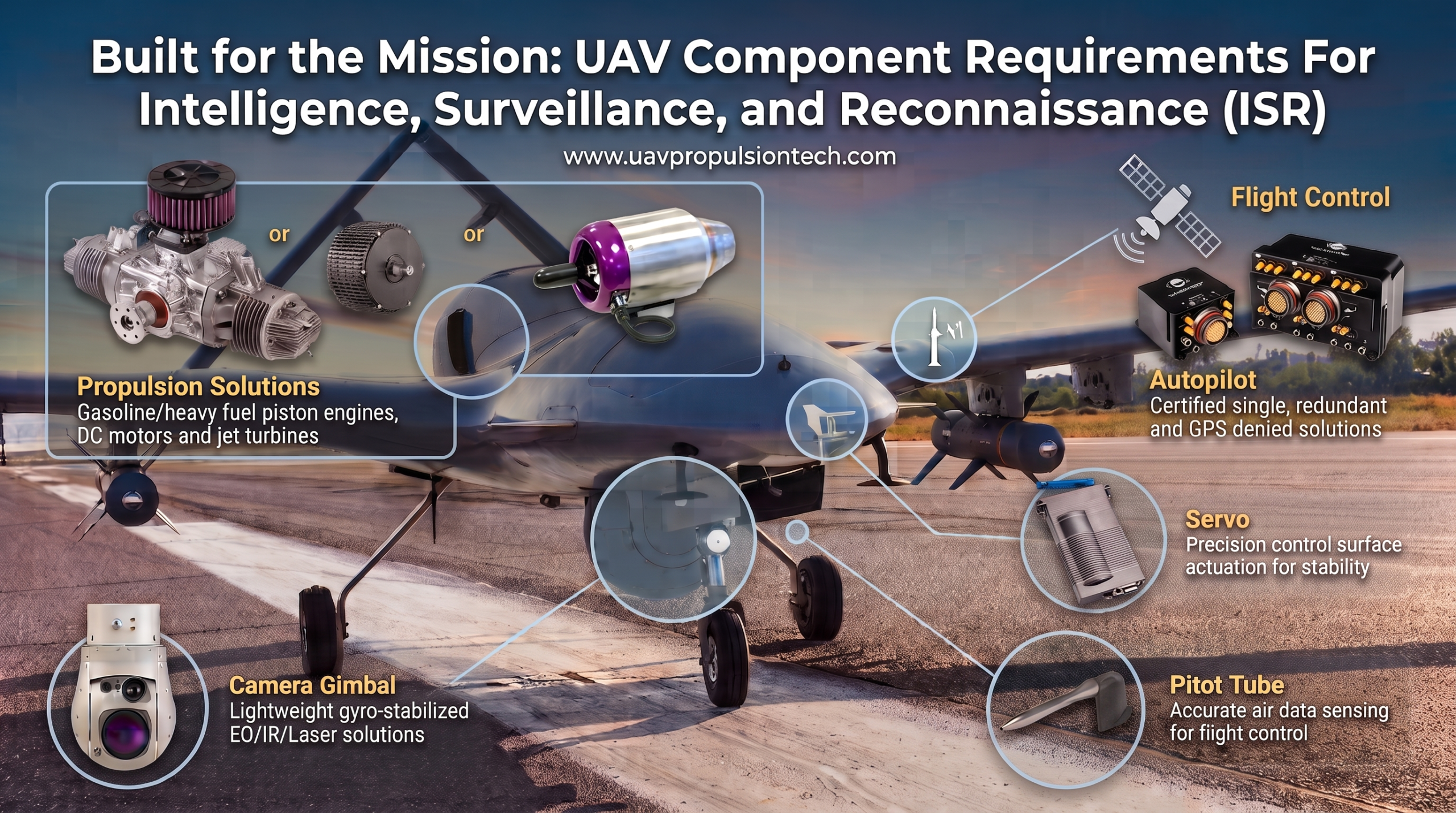
An ISR platform requires considerably more than an engine and a camera. Its architecture can include propulsion and power generation, fuel and engine monitoring, flight-control and navigation systems, actuators, propellers, fuel systems, communications and identification equipment, payload gimbals, and precision sensors.
UAV Propulsion Tech’s portfolio reflects this broader architecture. We offer propulsion and engines, fuel and engine sensors, navigation and autopilots, servos, fuel systems, propellers, fuel cells, transponders, electro-optical and infrared (EO/IR) gimbals, sensors, launch systems, and recovery parachutes. Its stated focus is on sourcing commercial off-the-shelf (COTS) and custom UAV technologies from international manufacturers and making those systems available to the U.S. and global UAV market.
For ISR, several of these categories become particularly important because they directly influence endurance, sensing quality, aircraft stability, and mission availability.
Propulsion: More Than Keeping the Aircraft Airborne
The propulsion system is often considered primarily in terms of thrust, but ISR introduces a broader requirement. The propulsion architecture must provide sufficient power while preserving payload capacity, endurance, thermal stability, and reliability. In some architectures, the propulsion system also contributes electrical power for avionics and payloads.
For a long-endurance ISR platform, this makes the selection process less about maximum horsepower and more about the relationship between power, weight, fuel consumption, reliability, and electrical requirements. UAV Propulsion Tech describes propulsion as an integrated ecosystem in which the engine, generator, engine management, mounting, and propeller can all influence the aircraft’s overall performance.
The engine mount is also significant. UAV Propulsion Tech notes that reducing vibration transmission to the payload can be critical because vibration can affect camera performance. For an ISR aircraft, propulsion and sensing are therefore connected in a way that is easy to overlook when components are considered separately.
EO/IR: Precision is non-negotiable
The propulsion system keeps the aircraft in the air, but the payload determines what the aircraft can observe. EO/IR systems consequently place particular importance on stabilization, vibration control, and consistent positioning.
The analogy is similar to mounting a precision telescope on a moving platform. The quality of the optical instrument matters, but so does the platform holding it. A highly capable camera cannot compensate indefinitely for unwanted vibration or unstable positioning. This is why the relationship between propulsion, mounting, actuation, and sensing becomes increasingly important as ISR requirements become more demanding.
Electro-optical and infrared payloads place particular emphasis on precision. The relevant components include imaging sensors, lenses and optical assemblies, stabilization mechanisms, processing electronics, thermal management systems, and supporting avionics. Their requirements are therefore influenced not only by resolution but also by how consistently that performance can be maintained under vibration, temperature changes, and extended operation.
For higher-cost ISR systems, this can justify selecting components with greater environmental margins, established qualification histories, and longer expected service lives. The objective is to preserve that performance over repeated missions and maintenance cycles.
SAR and RF Payloads: Electronics Under Continuous Demand
Search and Rescue (SAR) and signals intelligence payloads shift the component emphasis further toward high-performance electronics, processing, timing, antennas, and communications. Modern unmanned aerial systems (UAS) can integrate a range of payloads, including SAR and moving-target-indicator systems, signals intelligence and electronic sensing capabilities, communications relay equipment, and tactical processing systems. Together, these capabilities demonstrate the breadth of electronic functions that can coexist within an ISR architecture.
These payloads can place substantial demands on power, thermal management, data processing, and communications infrastructure. Consequently, the aircraft’s components cannot always be evaluated independently. UAV engineering therefore becomes an exercise in managing interactions between components rather than optimizing each component separately.
Power, Avionics, and Processing Are Mission Components
Power systems and avionics are sometimes treated as supporting infrastructure because they do not directly collect imagery or signals. In an ISR aircraft, however, their role is closer to that of a building’s electrical and communications infrastructure. They may not produce the visible output, but their failure can make the primary system unusable.
Higher-end ISR platforms therefore place considerable importance on power regulation, thermal control, flight computers, navigation systems, data buses, storage, and processing hardware. As payloads become more capable, the aircraft must also manage increasingly large quantities of information.
The component requirement consequently moves from having adequate computational capacity toward maintaining predictable performance over the aircraft’s intended service life. Long-life systems also benefit from architectures that allow individual components to be maintained, upgraded, or replaced without forcing unnecessary redesign of the entire platform.
Why the Sourcing Partner Matters
The challenge for an ISR manufacturer is finding components that fit the aircraft’s requirements and can be integrated into a coherent, supportable system.
This is where UAV Propulsion Tech’s role becomes particularly relevant. We have more than 20 years of experience in the UAV industry, with focus expanding from propulsion into a broader range of UAV systems. Our supplier network spans technologies from Germany, Spain, Switzerland, the United Kingdom, France, Israel, the Czech Republic, Poland, India, the Netherlands, Italy, and Estonia.
Our portfolio also includes both COTS and custom hardware, allowing the sourcing process to begin with established products and, where requirements become more specific, move toward customized solutions. Plettenberg, for example, describes a development approach in which projects can begin with COTS or modified off-the-shelf systems before progressing toward fully customized solutions as requirements become more defined.
The most suitable component is rarely the one with the most impressive specification in isolation. It is the one that fits the aircraft’s weight, power, environmental, endurance, integration, and reliability requirements without creating disproportionate problems elsewhere.