Fuel cells occupy a unique position in unmanned aerial vehicle (UAV) propulsion. They are not the loudest technology on the market, but for programs where endurance is the primary constraint, their performance is a crucial factor. Where a lithium battery reaches its ceiling in minutes, a hydrogen fuel cell system can sustain electric flight for several hours. For inspection, surveillance, and long-range BVLOS operations, it is often the decisive margin.
But the difference between understanding why fuel cells matter and making a well-informed sourcing decision is wider than most teams expect. The technology involves hydrogen storage, pressure regulation, hybrid power architecture, and thermal management, all of which need to fit within the weight and volume envelope of a specific platform. A poorly matched fuel cell system creates the same problems as any badly chosen propulsion component: integration delays, unexpected weight penalties, and performance that falls short of what the datasheet suggested.
Here are six factors every engineer, program manager, or procurement specialist should work through before sourcing a UAV fuel cell system.
1. Power Output Must Be Sized to the Mission
The instinct when evaluating a fuel cell is to match nominal power to the motor system. That instinct is correct but incomplete. Power demand on a UAV is not static, and the gap between average consumption and peak demand is where most early-stage sizing decisions go wrong.
A multirotor climbing at full throttle draws far more current than the same platform in steady cruise. A Vertical Take-Off and Landing (VTOL) transitioning between hover and forward flight spikes its power draw in ways that a simple cruise calculation will not capture. If the fuel cell is sized only against average mission power, those transient peaks either go unsupported or fall entirely on a battery backup that was never dimensioned to carry that load alone.
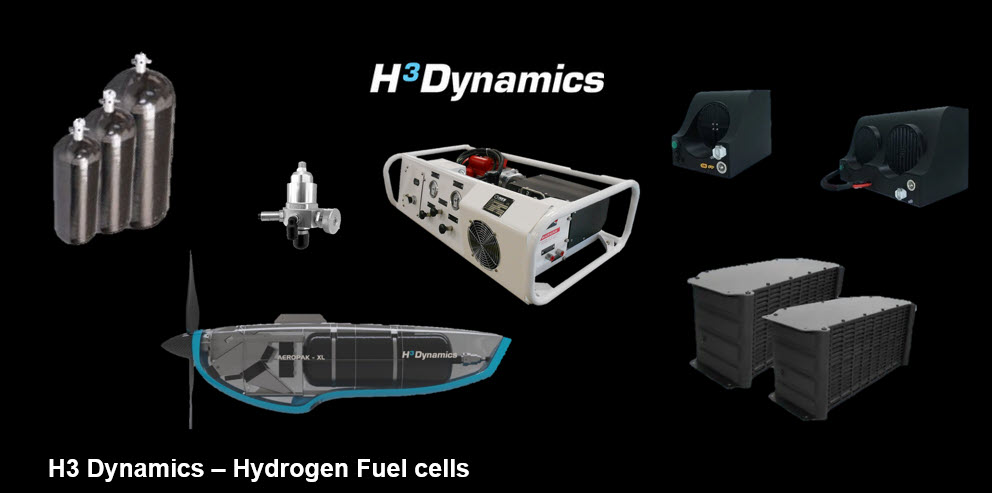
H3 Dynamics, UAV Propulsion Tech’s partner for fuel cell systems, addresses this through its AEROSTAK range, spanning from 300 W nominal at the lower end to 2,000 W for larger multirotors, fixed-wing, and VTOL platforms. Each system pairs the fuel cell stack with a Lithium Polymer (LiPo) hybrid architecture, where the battery absorbs transient peak loads that would otherwise strain the stack. The A-2000 sustains 2,000 W nominal while the hybrid battery can supply peak outputs of up to 8,000 W for short durations, providing meaningful headroom for the conditions a cruise power budget alone does not anticipate.
2. Specific Power Is the Weight Metric That Actually Drives Integration Decisions
Nominal power tells you what a fuel cell can produce. Specific power tells you what it costs in weight to produce it. For any UAV where payload fraction or endurance is constrained, specific power should be treated as a primary selection criterion from the earliest stages of system design.
The AEROSTAK systems bring a practical solution to this challenge. The A-800 delivers 645 W/kg at a total system weight of 1.23 kg, while the A-2000 produces 667 W/kg at 3 kg. These figures translate directly into integration flexibility. Every kilogram saved on the power system is a kilogram that can be reallocated to payload, hydrogen storage, or additional mission time. For programs working within tight maximum takeoff weight budgets, that margin is rarely abstract.
3. Hydrogen Storage Architecture Has Real Consequences for Field Operations
Hydrogen storage has its own unique design logic that is shaped by pressures, temperatures, and material demands that sit outside the established frameworks of battery-electric or conventional liquid fuel systems. Pressurized cylinders operating at several hundred bar require compatible pressure regulators, careful handling procedures, and cylinder certifications that vary by region. The physical dimensions and weight of the storage system affect the airframe’s center of gravity, structural loading, and available payload volume in ways that need to be worked through before an integration plan is finalized.
Field logistics add another layer of complexity. Unlike liquid fuel, hydrogen is not available at most forward operating locations, and sourcing it through industrial supply chains introduces dependencies that can constrain operational tempo. For programs that require flexibility in where they operate, this becomes a planning constraint that needs to be addressed at the system level.
H3 Dynamics offers two storage paths to address these different operational realities: pressurized gas cylinders for most use cases, and liquid hydrogen tanks for missions requiring maximum energy density. The A9 cylinder stores 216 grams of hydrogen at 2.65 kg total weight with an estimated 3,600 Wh of electrical energy. For remote deployments, H3 Dynamics’ mobile refilling station produces hydrogen from water on-site and can refill a 9-liter cylinder within hours, removing the supply chain dependency for teams that need that kind of field independence.
4. Hydrogen Purity Requirements Are Non-Negotiable and Demand Planning
Proton Exchange Membrane fuel cells are sensitive to hydrogen purity. Contaminants in the hydrogen supply degrade the membrane and reduce stack performance over time. Unlike a blocked fuel filter or a worn spark plug, membrane degradation accumulates gradually, eroding performance in ways that can be difficult to attribute to a specific source until meaningful damage has already occurred.
This makes purity a supply chain problem as much as a hardware problem. The quality of hydrogen available through industrial suppliers varies by region and by supplier, and confirming that a specific source consistently meets the required purity threshold is an ongoing operational requirement. For programs operating across multiple deployment locations, a supply chain that reliably delivers compliant hydrogen in one region may not translate to another.
Every AEROSTAK system specifies a hydrogen purity requirement of 99.998%. That threshold is achievable through established industrial supply chains, but it needs to be confirmed for each sourcing scenario. H3 Dynamics’ H2FIELD-1 mobile refilling station produces hydrogen at greater than 99.999% purity directly from water, which removes the supply chain variable entirely for teams willing to invest in that capability.
5. Startup Time and Thermal Behavior Shape How the System Integrates with Flight Operations
A fuel cell that takes several minutes to reach operational readiness adds a procedural layer to every flight. In applications involving rapid deployment or responsive tasking, that becomes a constraint that was not accounted for in the mission concept. A slow startup extends the pre-flight sequence and affects sortie rate, while also creating a window at the beginning of every flight where power availability is limited. For a multirotor launching from a confined area or a VTOL transitioning immediately after takeoff, that window is more important than just a procedural inconvenience.
Thermal behavior deserves equal attention. Proton Exchange Membrane (PEM) fuel cell stacks are sensitive to operating temperature, and performance outside the rated air temperature range degrades in ways that are not always linear or predictable. Programs operating in cold environments, at altitude, or in high-heat conditions need to understand how the stack behaves at those boundaries before the system reaches the field.
The AEROSTAK systems reach operational startup in under 20 seconds across the range, with a rated input air temperature range of 0 to 40 degrees Celsius. The hybrid battery integration means the power bus receives immediate supply on startup while the stack reaches its steady-state point, smoothing the transient that would otherwise require careful sequencing in the flight control architecture.
6. System Integration Support and Manufacturer Track Record Matter at Procurement
In UAV propulsion, the consequences of a component that fails to perform as specified in the field are severe. The manufacturer’s development history, testing protocols, and capacity for integration support are core evaluation criteria in the modern era.
H3 Dynamics has spent over a decade developing and delivering hydrogen-electric power systems for aerospace, defense, and commercial UAV applications worldwide. The AEROSTAK range is plug-and-play by design, with Recommended Standard 232 (RS-232) data communication for real-time monitoring of voltage, current, power, and temperature. Performance monitoring software is included as standard, with wireless telemetry, custom firmware development, and scalable power architecture available as add-ons for programs with more specific integration requirements.
Making the Right Fuel Cell Sourcing Decision
Sourcing a fuel cell for a UAV application means working carefully through power requirements, specific power figures, hydrogen storage architecture, purity constraints, startup and thermal characteristics, and manufacturer capability well before a unit is ordered.
UAV Propulsion Tech works directly with H3 Dynamics to match the right fuel cell system to each specific platform and mission profile. Whether a program is in early design or actively qualifying a power system for field deployment, UAV Propulsion Tech is ready to help navigate the process. Get in touch today to discuss your requirements and find the right solution.