Counter-UAS (cUAS) is increasingly becoming an exercise in economics as much as technology. When the threat consists of relatively inexpensive drones, the effectiveness of a countermeasure is not limited to whether it can defeat the target. The cost, availability, reliability, and scalability of the countermeasure also become important considerations.
This is particularly relevant for kinetic cUAS systems designed to address low-cost threats such as Shahed-type drones. The objective is to create a system whose overall architecture is appropriate for the operational and economic requirements of the mission.
That makes component selection a central part of cUAS development.
The Economics of the cUAS Problem
The growing availability of relatively inexpensive unmanned systems has changed the economics of air defense. A high-value defensive system may technically be capable of defeating a low-cost drone, but repeatedly using expensive interceptors against inexpensive targets can create an unfavorable cost relationship.
Low-cost kinetic cUAS systems attempt to address this challenge through a different approach.
Rather than treating the interceptor as a collection of individually optimized components, the system must be considered as an integrated platform. Propulsion, flight control, actuation, power, and aerodynamic components all contribute to whether the system can meet its intended requirements.
This places greater emphasis on components that provide predictable performance without creating unnecessary cost or integration complexity.
The same principle applies across different interceptor architectures. A high-speed system may require a turbine-based propulsion solution, while a smaller electric system may be better suited to an electric motor and propeller combination.
The component requirement begins with the mission.
Flight Control Is a Core Requirement
For any autonomous or highly automated unmanned platform, the flight-control system is one of the most important components in the architecture.
In cUAS applications, the requirement extends beyond basic aircraft stabilization. The flight-control system must operate as part of a broader system in which navigation, sensing, communications, and actuation work together.
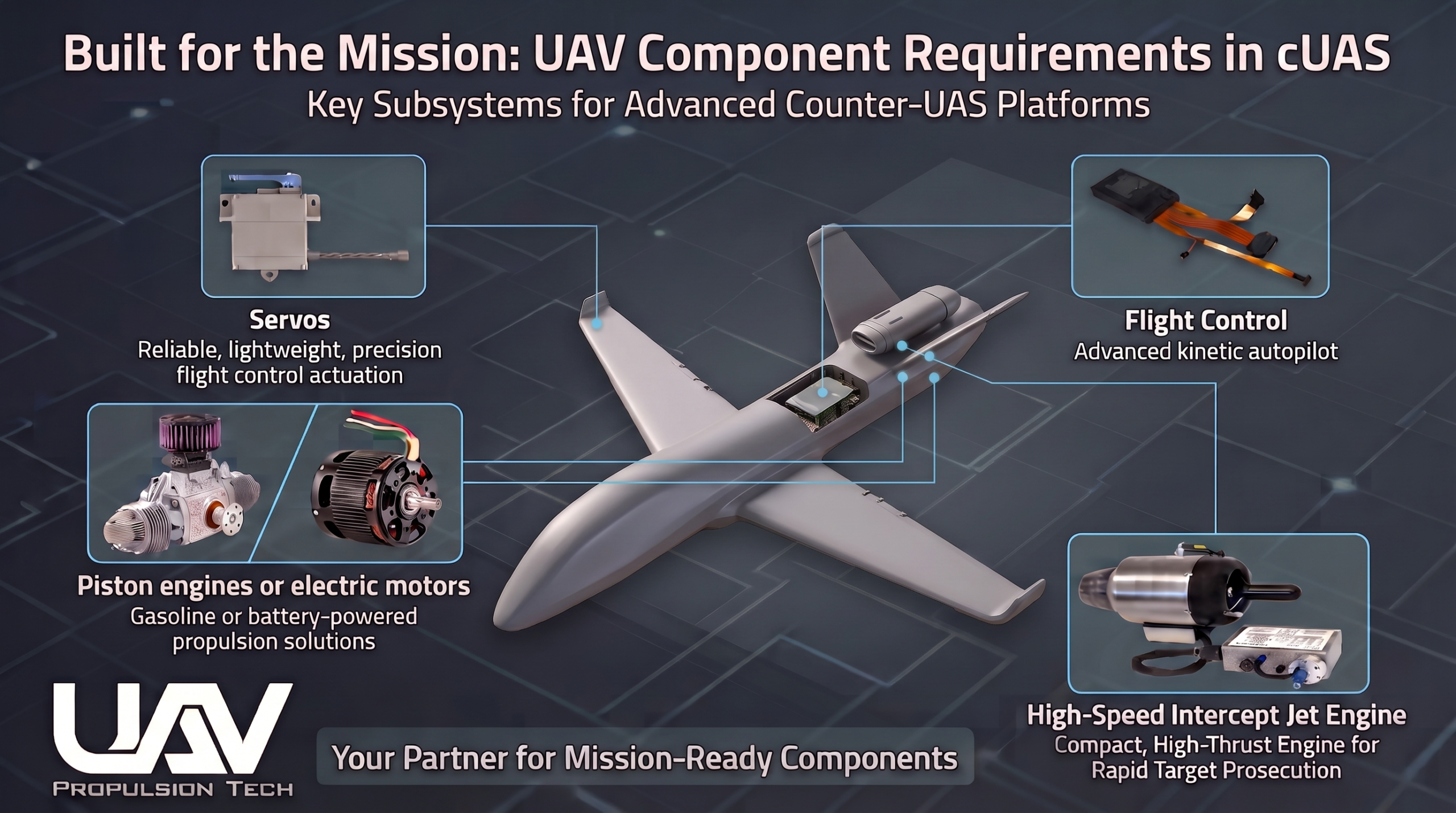
Embention’s Autopilot LM is an example of a flight-control system developed specifically for loitering-munition applications. The system combines flight control with computer vision capabilities and is designed to support autonomous operation, target tracking, and navigation in GNSS-denied environments. Embention also identifies functions including failsafe routines, sensor integration, payload activation, and data management within the system architecture.
For cUAS developers, the broader lesson is that the autopilot should be evaluated as part of the complete aircraft architecture rather than as an isolated avionics purchase.
The appropriate system is one that matches the platform’s requirements for reliability, integration, environmental conditions, and mission functionality.
Reliable Actuation Matters
Flight control ultimately depends on physical movement.
Servos and actuators translate commands from the flight-control system into movement of the aircraft’s control surfaces. In a system where the aircraft must maintain predictable flight behavior, actuator reliability therefore becomes an important component requirement.
This is particularly significant for single-use platforms. The value of an individual component is not determined solely by its purchase price. Reliability, consistency, environmental performance, and compatibility with the wider aircraft can all influence system availability.
A high-quality flight-control system cannot compensate for unreliable mechanical actuation.
For this reason, cUAS component architecture should consider the relationship between autopilot, servos, control surfaces, power supply, and airframe from the beginning of the design process.
The objective is a coherent control chain in which each component performs its intended function consistently.
High-Speed cUAS Requires a Different Propulsion Approach
Not every cUAS platform requires the same propulsion architecture.
Where higher-speed performance is a fundamental requirement, turbine propulsion can provide a different combination of thrust, acceleration, and power compared with smaller electric systems.
Advanced Micro Turbines (AMT), for example, offers a range of UAV turbine solutions. UAV Propulsion Tech identifies AMT’s turbines for high-speed target-drone applications, with its current range covering thrust levels from 230 N to 1,569 N. The company also describes the turbines as having high thrust-to-weight ratios, low fuel consumption, and rapid acceleration characteristics.
The important consideration is not simply selecting the turbine with the highest available thrust.
As with any UAV propulsion system, the propulsion requirement has to correspond to the aircraft’s overall architecture. Engine selection influences weight, fuel requirements, thermal considerations, integration, and the characteristics of the complete aircraft.
A turbine that is appropriate for one cUAS architecture may therefore be inappropriate for another.
Small Electric cUAS Platforms Present a Different Requirement
Smaller cUAS platforms can require a fundamentally different propulsion architecture.
Electric propulsion can provide a compact alternative where the aircraft’s size, power requirements, and mission profile make an electric system appropriate. In these applications, the motor and propeller should be considered as a matched propulsion system rather than independent components.
UAV Propulsion Tech’s portfolio includes Plettenberg electric propulsion systems and Mejzlik carbon-fiber propellers. Plettenberg provides COTS, modified off-the-shelf, and fully customized motor solutions, while its portfolio also includes electronic speed controllers and starter-generator systems.
Mejzlik, meanwhile, provides commercial-off-the-shelf (COTS) and custom carbon-fiber propeller solutions, with design and testing capabilities intended to match specific UAV requirements.
This illustrates an important principle in cUAS procurement: propulsion performance is an ecosystem consideration.
The motor, ESC, propeller, power source, and airframe must operate as a compatible system. Selecting an individual component based only on its headline specification can produce compromises elsewhere in the aircraft.
Component Reliability Is a System Requirement
For cUAS applications, the challenge is to reduce unnecessary system cost while retaining the reliability required for the intended mission. This is particularly important for components such as propulsion systems, autopilots, servos, and power electronics.
UAV Propulsion Tech’s broader sourcing approach reflects this distinction. Its portfolio includes both commercial off-the-shelf and customized Unmanned Aerial Vehicle (UAV) technologies, allowing manufacturers to select established products where they meet the requirement and consider modification where the application demands it.
Plettenberg describes a similar progression in its motor development approach. Projects can begin with COTS or modified off-the-shelf solutions and progress toward fully customized systems as requirements become more defined.
This approach can be particularly relevant to emerging cUAS platforms, where requirements may evolve during development.
The Importance of the Complete Propulsion System
We describe propulsion as an integrated ecosystem that can include the power source, generator, engine management, mounting, propeller, and associated systems. These components collectively influence aircraft performance.
The selected propulsion architecture influences available power, aircraft mass, endurance, thermal requirements, packaging, and integration. These factors subsequently influence the airframe and avionics architecture.
Consequently, propulsion should be considered early rather than treated as a component to be added after the rest of the aircraft has been designed.
Designing Around the Mission
The central lesson is that there is no universal cUAS component architecture.
A high-speed interceptor and a small electric platform may have completely different requirements. One may require turbine propulsion, while another may benefit from an electric motor and carbon-fiber propeller. Their flight-control, actuation, power, and integration requirements may differ accordingly.
What connects them is the need for mission-driven component selection.
The appropriate component is not necessarily the most powerful, the smallest, or the least expensive. It is the component that provides the required capability while fitting the aircraft’s wider requirements for cost, weight, reliability, integration, and availability.
Building the cUAS Supply Chain
As cUAS systems become more widely developed and deployed, component sourcing will become an increasingly important part of the engineering process.
Developers need access to propulsion, flight-control, actuation, sensing, and supporting technologies that can be integrated into complete aircraft architectures. They also need suppliers capable of understanding how individual components interact within the broader system.
That is where our role extends beyond supplying individual hardware.
Our portfolio brings together propulsion systems, motors, propellers, autopilots, servos, and other UAV technologies from specialized manufacturers. The objective is to help UAV developers identify components that fit the requirements of their specific platforms rather than selecting hardware in isolation.
The future of affordable cUAS technology will depend not only on developing capable interceptors, but also on developing the component architectures that make those systems practical, reliable, and scalable.