
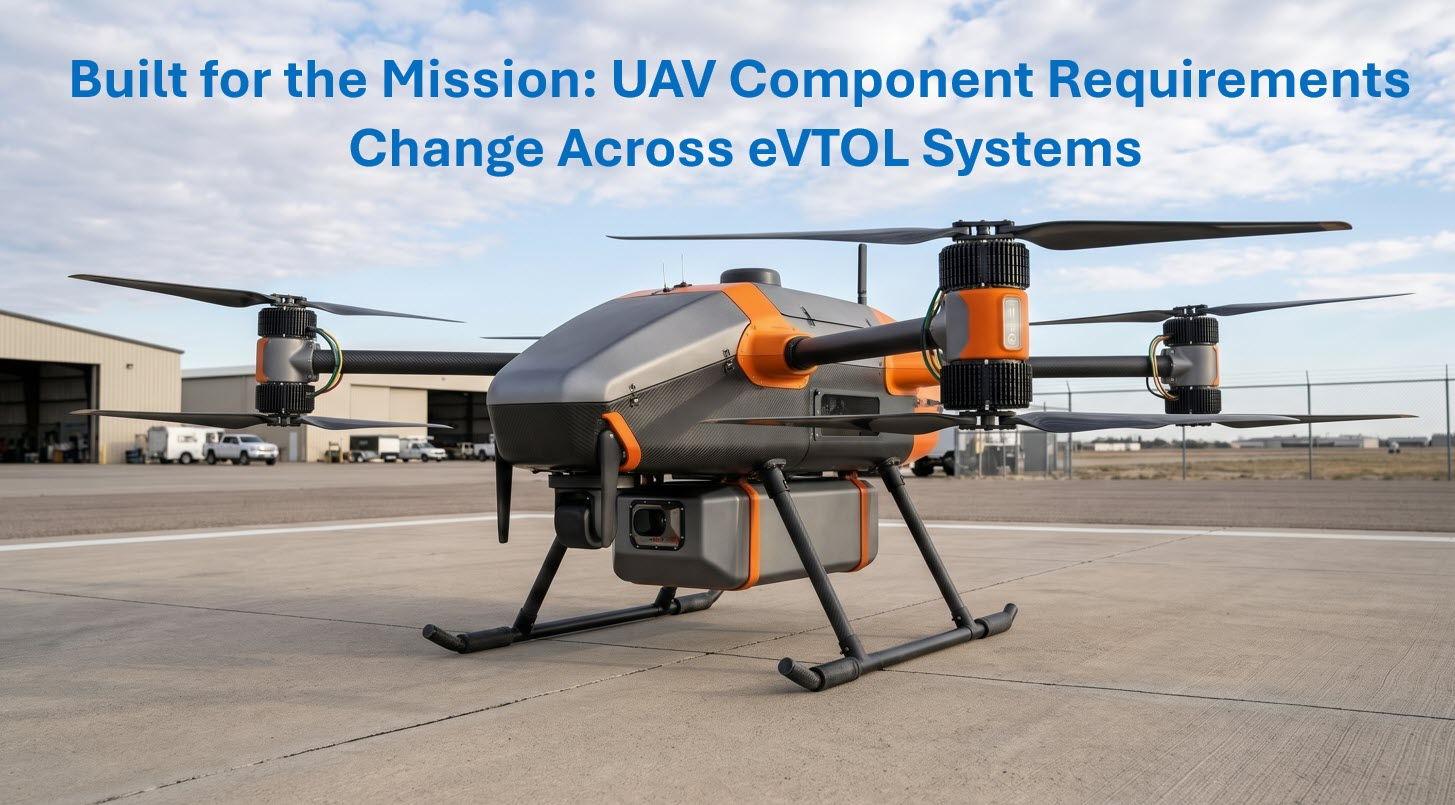
Electric vertical take-off and landing (eVTOL) aircraft bring a unique set of challenges to UAV propulsion. Unlike conventional fixed-wing aircraft, they need to generate enough power to take off vertically, remain stable while hovering and transition into forward flight. Each stage places different demands on the motors, propellers, power supply and cooling systems.
For aircraft manufacturers, choosing the right components means looking at how the entire aircraft will operate. Motors must provide enough power for take-off and landing, propellers must deliver the required thrust, and the power system must support the aircraft throughout its mission. In hybrid-electric aircraft, an additional challenge is ensuring that the engine and generator can provide enough electricity to support the electric motors.
Understanding these requirements helps manufacturers select components that work together and meet the needs of their aircraft.
Understanding the Propulsion Requirements of eVTOL Aircraft
Not all eVTOL aircraft use the same propulsion arrangement. Some have separate propellers for vertical lift and forward flight, while others use motors and propellers that change position as the aircraft moves between hovering and cruising. There are also designs that use several smaller motors and propellers distributed across the aircraft.
These different arrangements affect the type of propulsion components required. During take-off, the motors must produce enough thrust to lift the aircraft and its payload. While hovering, they must maintain this thrust for an extended period without overheating. Once the aircraft moves into forward flight, the demands on the propulsion system change as the wings begin to provide more lift.
Research by NASA into distributed electric propulsion also highlights how multiple motors and propellers can contribute to aircraft performance, while pointing to the importance of designing these components to work together.
Lift Motors: Balancing Power, Weight and Thermal Performance
Lift motors play an important role in eVTOL aircraft because they provide the power needed for vertical take-off and landing. They must generate enough thrust to lift the aircraft while keeping their weight within the limits of the overall design.
The requirements also change depending on how long the aircraft needs to hover. A motor may provide high peak power for take-off, but it must also be capable of handling the demands of sustained operation. Heat generated during these periods needs to be managed to prevent performance problems.
The Plettenberg NOVA series offers motor options for applications where power, weight and reliable operation are important. For example, the NOVA 15 LW is a closed-housing, inrunner BLDC motor designed for demanding uncrewed and aerospace applications. Its published specifications include up to 20 kW peak power, 55 Nm peak torque and a maximum speed of 11,000 RPM, depending on the configuration. The motor has a starting weight of 1,400 g and uses air cooling.
The NOVA range also includes water-cooled options, such as the NOVA 15 WK. This gives manufacturers another choice when the aircraft design requires a different approach to heat management.
When selecting a lift motor, manufacturers need to consider the aircraft’s weight, the number of motors, the required thrust and the time spent hovering. The Plettenberg NOVA range provides options that can be considered against these requirements.
Propeller Selection: Matching Thrust Requirements to Motor Performance
Motor selection alone does not determine the performance of an electric propulsion unit. The propeller influences how effectively motor power is converted into thrust, making its diameter, pitch, blade geometry and rotational speed important design parameters.
In eVTOL aircraft, the distinction between hover and forward-flight requirements is particularly relevant. During hover, the propeller must generate sufficient thrust at relatively low forward airspeed. During transition and cruise, the aerodynamic conditions change, affecting the relationship between rotational speed, torque and propulsive efficiency.
Mejzlik Propellers offers carbon-fibre solutions for multicopter and VTOL applications. Its product portfolio includes dedicated VTOL propellers, with different diameters, pitches and rotational configurations. For example, the 30×11 2B VTOL propeller has a published mass of 123 g and a maximum static thrust rating of 34.7 kgf. Its datasheet also specifies operating limits for hover RPM and forward speed.
The company also develops propellers for multicopter applications, including configurations designed around hover performance and higher-load operating conditions.
These specifications illustrate why propeller selection must account for the complete propulsion unit. Mejzlik’s COTS and custom propeller options allow developers to evaluate the relationship between motor output, thrust requirements and aircraft operating conditions.
Hybrid Power Generation: Sizing the Generator Around the Mission
Hybrid-electric eVTOL configurations introduce a further challenge because electrical power must be generated and distributed to the propulsion system throughout the mission. Depending on the architecture, a combustion engine coupled to a generator can supply electrical power to the motors, recharge the battery or support other onboard systems.
Generator sizing requires an understanding of the aircraft’s electrical demand across different flight phases. The combined peak ratings of the lift motors alone are insufficient for determining generator capacity, since not every motor necessarily operates at maximum output simultaneously throughout the mission.
Instead, the design process should consider the expected continuous electrical load, the duration of each operating phase, the power required during transition and cruise, and the contribution of the battery to short-duration peak demands. The generator must be sized to support the required energy profile while accounting for conversion losses and onboard electrical consumption.
Research published through SAE on eVTOL electric propulsion design similarly emphasizes analyzing power and energy consumption across individual flight phases before selecting and matching the motor, controller, propeller and battery.
The Suter TOA 330-APU addresses the requirements of hybrid propulsion through an integrated engine-generator configuration. Based on a 330 cc twin-opposed, two-stroke engine, the system delivers 17 kW of continuous electrical output at 60 V DC, with a peak output of 18.7 kW after voltage regulation. Its published configuration includes an engine, exhaust and generator, with a combined listed component weight of approximately 20.3 kg.
The APU is designed for hybrid UAVs, electric aircraft range-extender systems and platforms requiring additional electrical power. Its direct-drive generator architecture eliminates the need for a clutch, while fuel options include gasoline and kerosene-based fuels such as Jet-A1, JP-5 and JP-8 compatibility.
For an eVTOL application, the TOA 330-APU’s suitability would depend on the aircraft’s electrical architecture and mission demand. Its continuous output must be evaluated against the sustained power requirement, while the battery can be considered for handling transient loads and providing additional power during demanding flight phases. Suter is also developing a larger engine HF-TOA660-SDI that will provide 37.5kW of electrical power. This solution will be available to customers in Q1 2027.
Cooling and Airflow: An Essential Part of Propulsion Integration
Cooling is another important part of eVTOL propulsion design. Motors, generators and engines produce heat while operating, and this heat must be managed to maintain reliable performance.
One challenge is that the amount of airflow available can change depending on the aircraft’s flight stage and component placement. For example, a component positioned near a propeller may receive airflow generated during flight. However, a generator installed inside the airframe or away from the propeller may not receive the same cooling benefit.
The Suter TOA 330-APU uses a forced-ventilation generator, helping provide the airflow needed for its electrical generation system.
Suter’s engineering approach considers cooling alongside other installation requirements, including mounting, generator configuration, exhaust systems and electrical connections. This allows the cooling arrangement to be planned around the aircraft rather than treated as a separate requirement.
Understanding Flight Control Requirements of eVTOL aircraft
Embention’s Veronte Autopilot solutions integrate into eVTOL aircraft as a centralized, certifiable flight control system that manages complex aerodynamics, propulsion, and avionics across every phase of flight. Featuring a platform-agnostic, user-programmable architecture supporting custom C++ modules and Model-Based Design—the system seamlessly coordinates actuator mixing and continuous control blending to handle critical transitions between vertical hover and forward cruise across tiltrotor, tiltwing, vectored-thrust, and lift-and-cruise configurations.
Through a modular ecosystem of I/O expansion boards, high-voltage motor controllers, ground control stations, and onboard cockpit Human-Machine Interfaces (HMIs), Veronte connects directly with distributed electric propulsion units, sensors, and communication links while supporting piloted, fly-by-wire, and fully autonomous operations.
Built with fail-operational hardware redundancy (such as the Veronte Autopilot 4x) and developed in accordance with DO-178C, DO-254, and DO-160 standards, the solution also provides comprehensive certification datapacks and Iron Bird testing support to help eVTOL manufacturers achieve airworthiness and Type Certification.
Why Component Integration Matters
Choosing individual components is only one part of developing an effective eVTOL propulsion system. Motors, propellers, generators and cooling systems must all work together to meet the aircraft’s requirements.
This is where having access to different propulsion technologies and suitable engineering support becomes valuable.
UAV Propulsion Tech brings together Suter combustion engines and hybrid power systems, Plettenberg electric motors and Mejzlik carbon-fibre propellers. These product ranges cover different parts of the propulsion system, giving manufacturers options when selecting components for their aircraft.
Whether the requirement involves lift motors for vertical flight, propellers designed for specific thrust demands or an APU for hybrid power generation, component selection should begin with the aircraft’s intended mission.
As eVTOL designs continue to develop, choosing components that match the aircraft’s operating requirements will remain an important part of building propulsion systems that deliver the necessary power, endurance and reliability.