Choosing the right motor or generator for a UAV is one of the most pivotal decisions in the entire development cycle. The propulsion system determines thrust capacity, endurance, thermal stability, operating cost, and long-term mission viability.
Whether you’re developing a multicopter for persistent surveillance, a VTOL platform for logistics, or a hybrid-electric UAV for defense applications, the sourcing criteria goes far beyond peak power output.
Here are six critical factors to consider before sourcing UAV motors and generators.
1. Power-to-Weight-to-Robustness Ratio Determines Mission Capability
Weight is the primary constraint in UAV propulsion design. Every gram given to the motor is a gram taken from payload, fuel, or battery capacity. But raw weight alone is not the right metric. The ratio that is actually of significance is power-to-weight-to-robustness. The metric tells how much useful output a motor delivers per unit of mass, while surviving the thermal, shock, and vibration loads of real-world operations.
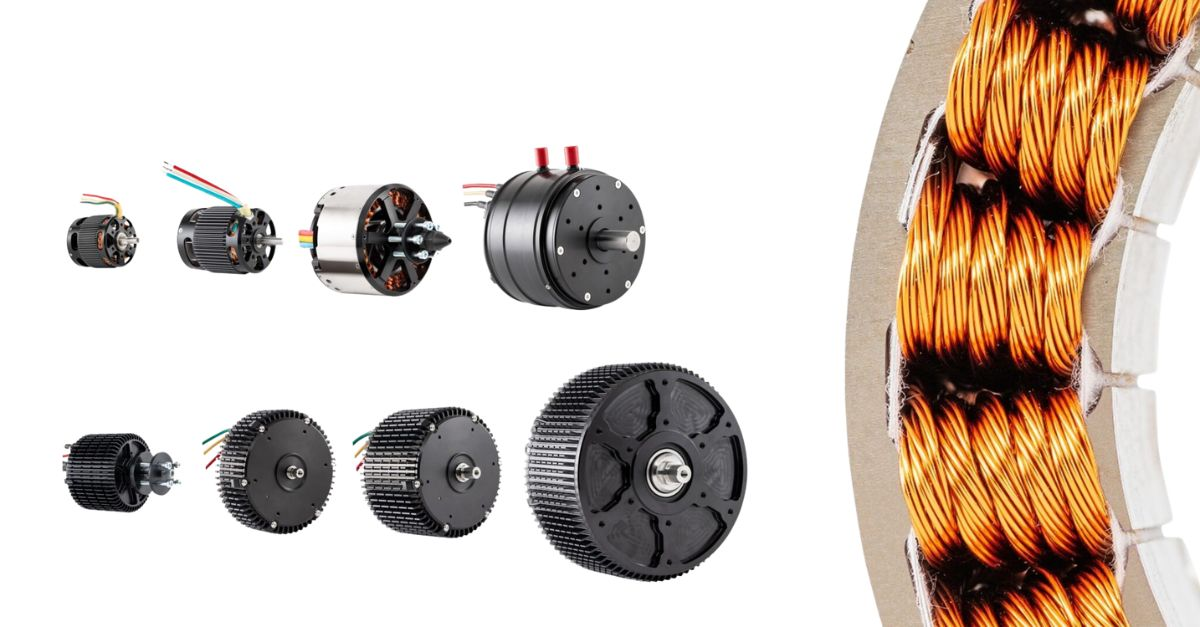
Plettenberg motors is engineered around this principle. The NOVA series of inrunner Brushless DC (BLDC) motors delivers market-leading power-to-weight ratios in a rugged closed-housing design, with MIL-STD 810H qualification. This makes the NOVA series ideal for applications in harsh environmental conditions, providing the best total-cost-of-ownership. The NOVA series is available from 12 kg to 115 kg peak thrust, for UAVs with MTOW from 30 kg to 260 kg (quad design).
For customers which are more concerned about the power-to-weight and may accept a lower level of robustness, Plettenberg offers the ORBIT series of outrunner BLDC motors. The brand-new ORBIT series is released in 2026 and comprises six platform products that can be customized to thousands of versions. The new ORBIT series is available from 5 kg to 65 kg peak thrust and for UAVs with MTOW from 10 kg to 130 kg (quad design).
2. Rare Earth Magnet Supply Is a Strategic Procurement Risk
High-performance BLDC motors depend on rare earth permanent magnets to achieve the flux densities required for competitive power-to-weight ratios. The problem is that over 90 percent of global rare earth magnet production is concentrated in China, creating a significant and growing supply chain vulnerability for defense and critical infrastructure programs.
Recent export restrictions and geopolitical tension have already disrupted rare earth availability and pricing. For program managers sourcing motors for defense UAV platforms, this is not a theoretical risk. It is an active procurement challenge that must be evaluated at the component sourcing level.
Plettenberg addresses this directly. All motors are going through a dual qualification, so that every product can be optionally offered with non-Chinese / DFRAS compliant magnets. This allows maintaining supply continuity independent of Chinese export policy. For programs operating under the National Defense Authorization Act (NDAA) or Defense Federal Acquisition Regulation Supplement (DFARS), serial Plettenberg products are fully compliant for integration in US and defense-related applications.
3. The Significance of MIL-STD Qualification
Datasheet performance figures are measured under controlled laboratory conditions. Real UAV operations are not controlled. Motors are exposed to temperature extremes, wind-blown sand, salt fog, rain immersion, high-altitude pressure drops, and sustained mechanical vibration and more than often in combination.
A motor that meets its rated output in a test cell but fails in the field is not a functional propulsion solution. MIL-STD 810H qualification provides independent verification that a motor can survive the conditions it will actually encounter. Plettenberg’s NOVA 4 and NOVA 15 Commercial-Off-The-Shelf (COTS) product lines have been fully qualified to MIL-STD 810H, covering 14 test categories including:
- Low pressure operation to 70,000 ft altitude
- Temperature extremes from -65°C storage to 135°C storage and 100°C operating
- Salt fog, humidity, rain immersion to 1 m depth
- Shock at 20 g peak and vibration across 10–2,000 Hz
- Sand and dust exposure with particles up to 850 µm
4. System-Level Integration Requires More Than a Motor Selection
A motor that is optimal on paper can still create serious integration challenges if the Electronic Speed Controller (ESC), power electronics, propeller, thermal management, and mounting configuration are not engineered as a coherent system.
For hybrid-electric UAS platforms, this complexity extends further. Starter-generator systems must convert engine output to clean, regulated DC power for battery charging, ESC bus supply, and onboard avionics across a wide RPM range, in hot compartments, under vibration.
Plettenberg offers a complete electric drive ecosystem: BLDC motors, high-performance ESCs, outrunner and inrunner starter-generators (ORBIT SG and NOVA SG series), and the new SGCU — a Starter-Generator Control Unit that handles 3-phase AC-to-DC conversion, DC/DC regulation, battery charging, avionics supply, and integrated engine starting in a single unit. The SGCU will be offered in Base, Military (MIL-STD 810H and 461G), and Aerospace (DO-160, DO-178, DO-254) variants.
This ecosystem approach reduces integration risk, simplifies qualification, and ensures that every component is matched to operate correctly under the actual mission load profile.
5. Supply Chain Transparency is a Non-Negotiable for Defense Programs
In today’s procurement environment, the origin of components is not a secondary consideration. It is a primary gate for program funding, export licensing, and operational deployment with allied partners. NDAA Section 889 and related provisions increasingly require integrators to verify that components are free of prohibited-country content. The verification must extend to the sub-component level.
Plettenberg manufactures 100 percent of its products at its headquarters in Germany, under an EN 9100:2018 certified quality management system. The supply base is fully European. This provides procurement teams with the documentation trail required for modern defense acquisition, including compliance with Swiss and EU dual-use export regulations.
Plettenberg has established relationships and delivers into many different programs of the world’s leading UAV, aerospace and defense OEMs. The supply chain integrity has been validated across some of the most demanding defense programs in operation today.
6. Customization Capability Determines Whether a Motor Actually Fits Your Platform
No two UAV platforms have identical mission profiles. Thrust requirements, voltage bus architecture, propeller dimensions, operating altitude, thermal environment, and duty cycle all vary. A motor optimized for one application may be significantly underperforming or oversized for another.
Plettenberg approaches this through a tiered customization model: COTS for standard configurations, Modified-Off-The-Shelf (MOTS) for custom winding to match a specific Kv requirement, and Fully Custom for complex mechanical or electrical development programs. Every MOTS or custom engagement begins with a detailed engineering study — reviewing the mission load profile, running thermal simulations, and sizing the motor to cover critical load points with an appropriate safety margin.
The engineering team provides integration support, propeller-motor matching studies, thermal design review, and full lifecycle documentation. For customers, this process produced a custom NOVA 15 LW motor tailored to survive maritime, desert, and rain operations while delivering exceptional efficiency across the platform’s full load profile.
Making the Right Motor Sourcing Decision
Sourcing a UAV electric motor or generator means evaluating power-to-weight-to-robustness ratio, rare earth supply chain risk, MIL-STD qualification, system integration capability, component origin transparency, and mission-specific customization depth.
At UAV Propulsion Tech, we work closely with manufacturers like Plettenberg to match the right propulsion solution to each mission profile. Contact UAV Propulsion Tech to discuss your requirements.